
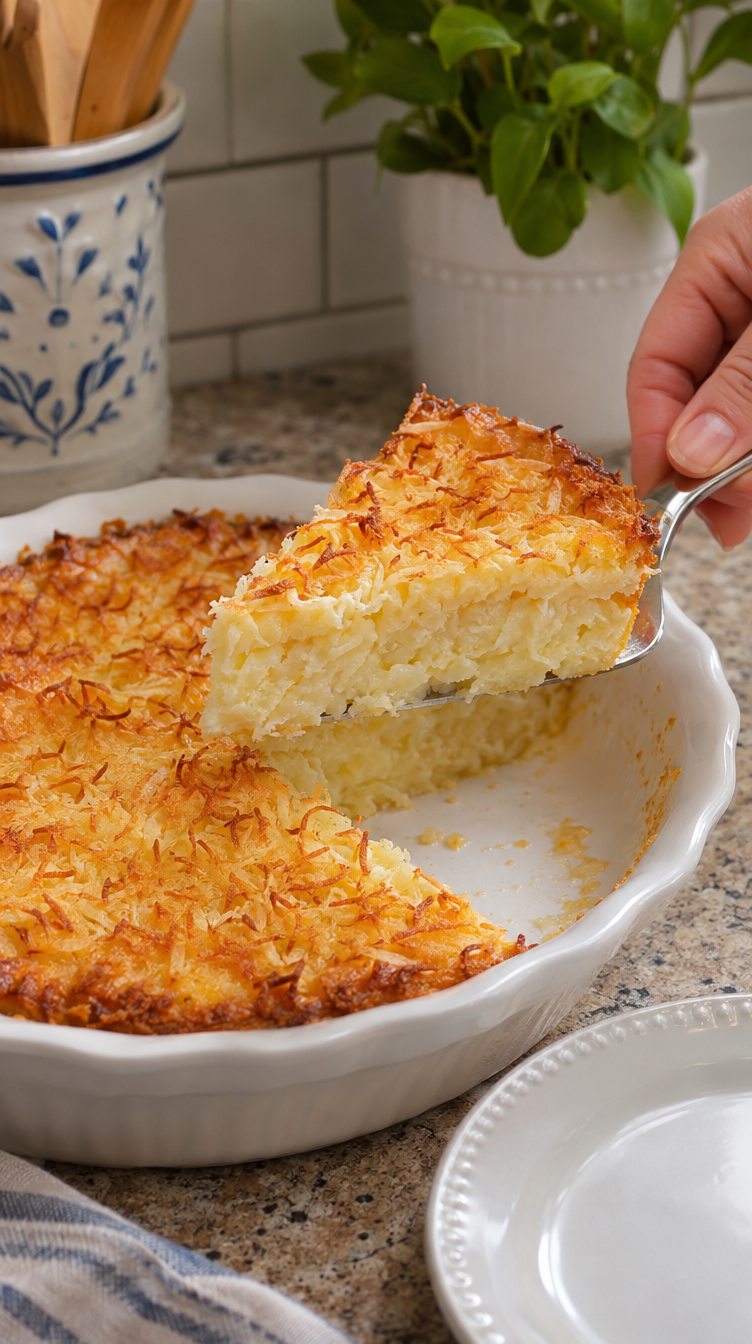
Sugar-Free Coconut Pie – Easy, Creamy & Crustless
Sugar-Free Coconut Pie is an easy crustless dessert made with eggs, unsweetened coconut milk, shredded coconut, coconut flour, butter, vanilla, and a granulated erythritol–monk fruit sweetener instead of added sugar. It bakes into a soft, custard-like center with a lightly golden coconut top and requires no traditional pastry crust.
This recipe is especially useful when you want a simple coconut dessert without rolling dough, blind baking pastry, or preparing a separate pie shell.
The coconut flour helps give the filling structure, while shredded coconut adds texture throughout the pie. Eggs create the custard-style base, and full-fat coconut milk contributes richness and coconut flavor.
After baking, the pie needs time to cool and chill. That resting period helps the filling become firmer and makes cleaner slices easier to achieve.
Although this recipe uses a sugar replacement instead of added granulated sugar, always check the labels of your coconut milk, shredded coconut, extracts, and sweetener if you have specific dietary requirements.
Why You’ll Love This Sugar-Free Coconut Pie
A traditional coconut pie often involves a pastry crust and a filling sweetened with sugar. This version simplifies both parts.
There is no traditional crust to prepare, and the filling uses a 1:1 erythritol–monk fruit sweetener instead of added table sugar.
You’ll love this recipe because it is:
- Made without a traditional pie crust
- Sweetened without added granulated sugar
- Rich in coconut flavor
- Creamy in the center
- Lightly golden on top
- Easy to mix in one bowl
- Made with familiar ingredients
- Suitable for holiday dessert tables
- Easy to prepare ahead
- Delicious served chilled
The recipe is also straightforward enough for everyday baking.
Rather than making dough, chilling pastry, and rolling a crust, you simply mix the filling and pour it into a greased pie dish.
Sugar-Free Coconut Pie Ingredients
You’ll need:
- 4 large eggs
- 1/2 cup granulated erythritol–monk fruit sweetener designed as a 1:1 sugar replacement
- 1 cup unsweetened full-fat coconut milk
- 1 cup unsweetened shredded coconut
- 2 tablespoons coconut flour
- 2 tablespoons unsalted butter, melted
- 1 teaspoon vanilla extract
- 1/2 teaspoon coconut extract, optional
- 1/4 teaspoon salt
- 1/2 teaspoon baking powder
The ingredient list is relatively short, but each ingredient contributes something important to the finished texture.
Understanding the Main Ingredients
Eggs
Four large eggs form the foundation of the custard-like filling.
They help bind the coconut milk, coconut flour, shredded coconut, butter, and sweetener into a sliceable pie.
Because eggs are essential to the structure, they shouldn’t simply be omitted without reformulating the recipe.
Erythritol–Monk Fruit Sweetener
The recipe calls for a granulated erythritol–monk fruit blend that is formulated as a 1:1 sugar replacement.
That detail matters.
Different monk fruit products vary widely in concentration. Some are blended with erythritol or other ingredients to measure like sugar, while others are highly concentrated.
Use the product according to its label and make sure it is designed for cup-for-cup substitution.
The flavor and cooling sensation can also vary between brands.
Full-Fat Coconut Milk
Unsweetened full-fat coconut milk contributes richness and coconut flavor.
Shake or stir the coconut milk as directed on the package if the solids and liquids have separated.
Using an unsweetened product gives you better control over the sweetness of the recipe.
Unsweetened Shredded Coconut
Shredded coconut adds texture and intensifies the coconut flavor.
It also helps create the lightly textured top as the pie bakes.
Use unsweetened coconut if you want to keep the recipe consistent with the no-added-sugar approach.
Coconut Flour
Coconut flour absorbs liquid very efficiently.
Only two tablespoons are needed in this recipe.
It helps give the filling structure while keeping the recipe crustless.
Avoid casually replacing it cup-for-cup with all-purpose flour because coconut flour behaves very differently.
Butter
Two tablespoons of melted unsalted butter add richness and help round out the coconut flavor.
Allow extremely hot melted butter to cool slightly before adding it to the egg mixture.
Vanilla and Coconut Extract
Vanilla adds familiar dessert flavor.
Coconut extract is optional but can make the coconut flavor more pronounced.
Start with the specified amount because extracts can be strong.
Baking Powder
A small amount of baking powder provides a little lift and contributes to the finished texture.
Salt
Just 1/4 teaspoon of salt helps balance the sweetness and enhances the other flavors.
What Makes This Coconut Pie Crustless?
A crustless pie skips the separate pastry shell entirely.
Instead of pouring filling into pie dough, the coconut mixture goes directly into a greased pie dish.
The eggs and coconut flour help the filling set enough to hold its shape after baking and chilling.
This doesn’t mean the pie develops a traditional flaky crust on the bottom.
Instead, you get a soft coconut custard with a firmer exterior and a lightly golden coconut surface.
The result is simpler than a standard pie because you don’t need to:
- Make pastry dough
- Roll a crust
- Chill the dough
- Blind bake a crust
- Crimp pastry edges
- Use pie weights
That simplicity makes this recipe particularly convenient when you want a homemade dessert with less preparation.
Is This Pie Really Sugar-Free?
The recipe uses a sugar replacement instead of added granulated or brown sugar.
However, the safest way to describe the recipe for most readers is “no added sugar” unless you have verified the nutrition labels of every ingredient.
Coconut milk and shredded coconut can contain naturally occurring sugars, and packaged products can vary.
Sweetener blends can vary too.
For someone tracking carbohydrates, sugar, calories, or a medically prescribed diet, the actual product labels and serving size matter.
This recipe should therefore not automatically be described as keto, diabetic-friendly, zero-carb, or zero-sugar without a verified nutrition calculation.
How to Make Sugar-Free Coconut Pie
Step 1: Preheat the Oven
Preheat your oven to 350°F (175°C).
Lightly grease a 9-inch pie dish.
Greasing the dish helps prevent the custard-like filling from sticking excessively around the bottom and edges.
Step 2: Beat the Eggs and Sweetener
Crack four large eggs into a large mixing bowl.
Add:
- 1/2 cup granulated erythritol–monk fruit sweetener
Whisk until the mixture is smooth and evenly combined.
You don’t need to whip the eggs into a large volume of foam.
The goal is simply to create an even base.
Step 3: Add the Liquid Ingredients
Stir in:
- 1 cup unsweetened full-fat coconut milk
- 2 tablespoons melted butter
- 1 teaspoon vanilla extract
- 1/2 teaspoon coconut extract, if using
Mix until smooth.
If your melted butter is extremely hot, let it cool slightly first so it doesn’t hit the eggs at a very high temperature.
Step 4: Add the Dry Ingredients
Add:
- 2 tablespoons coconut flour
- 1/2 teaspoon baking powder
- 1/4 teaspoon salt
Whisk or stir until the ingredients are evenly incorporated.
Coconut flour can absorb liquid quickly, so take a moment to break up any visible lumps.
Step 5: Fold in the Coconut
Add one cup of unsweetened shredded coconut.
Fold it through the mixture until evenly distributed.
Step 6: Rest the Mixture
Let the mixture sit for approximately 5 minutes.
This short rest gives the coconut flour time to begin absorbing liquid.
You may notice the mixture thickening slightly.
Step 7: Pour Into the Pie Dish
Pour the coconut mixture into your prepared 9-inch pie dish.
Spread the shredded coconut evenly if necessary.
The mixture should settle into a fairly even layer.
Step 8: Bake
Place the pie in the preheated oven.
Bake for approximately 35–45 minutes.
The top should become lightly golden and the center should appear set rather than liquid.
Because this is an egg-based dessert, checking doneness with a food thermometer can provide a useful safety check. USDA guidance says dishes containing eggs should reach 160°F (71°C).
Step 9: Cool Completely
Remove the pie from the oven.
Let it cool completely.
Avoid trying to cut neat slices while the filling is still very warm.
The structure continues to settle as the pie cools.
Step 10: Refrigerate
Once cooled appropriately, refrigerate the pie for at least 2 hours.
This chilling time helps firm the custard-like filling and produces cleaner slices.
Step 11: Slice and Serve
Cut the chilled pie into slices with a clean knife.
Serve chilled or allow a slice to sit briefly at room temperature according to preference.
How to Know When Sugar-Free Coconut Pie Is Done
Knowing when a custard-style pie is finished can be more difficult than testing a cake.
You don’t necessarily want to wait until the entire filling looks dry.
Instead, look for several signs together.
The top should be lightly golden.
The outside edge should look set.
The middle should no longer appear liquid.
There may still be a small amount of movement in the center immediately after baking, but it shouldn’t look like uncooked batter.
For this egg-based pie, the recipe specifies an internal temperature of 160°F (71°C), which is consistent with USDA guidance for dishes containing eggs.
Insert the thermometer near the center without touching the pie dish.
Once it reaches the proper temperature and the appearance matches the expected doneness, remove it from the oven.
Why Does the Pie Need to Chill?
Chilling is not only about serving temperature.
It also affects texture.
When the pie first comes out of the oven, the filling is hot and relatively delicate.
As it cools, the egg-based structure firms.
Refrigeration further sets the custard-like center.
That’s why the recipe recommends at least two hours in the refrigerator before slicing.
If you cut the pie too early, the filling may appear softer than expected even if it was properly baked.
For especially neat slices, use a sharp knife and wipe the blade between cuts.
Tips for the Best Sugar-Free Coconut Pie
Use the Correct Sweetener
Look for a granulated erythritol–monk fruit product specifically labeled as a 1:1 sugar replacement.
Do not assume every monk fruit product measures the same way.
Use Unsweetened Coconut Products
Check both your coconut milk and shredded coconut.
Sweetened shredded coconut would change the sweetness and no-added-sugar positioning of the recipe.
Use Full-Fat Coconut Milk
The recipe is formulated with full-fat coconut milk, which contributes richness and body.
A lower-fat substitute can produce a different texture.
Measure Coconut Flour Carefully
Coconut flour is very absorbent.
Two tablespoons may look like a small amount, but adding significantly more can make the finished pie dry.
Let the Mixture Rest
The five-minute rest gives the coconut flour time to hydrate before baking.
Don’t Overbake
Once the center is set and the pie reaches the proper temperature, remove it from the oven.
Unnecessarily long baking can make an egg-based custard firmer or drier than intended.
Cool Before Refrigerating
Allow the pie to cool appropriately before chilling.
Chill Before Slicing
For the cleanest slices, give the pie the full two-hour refrigeration period.
Common Mistakes to Avoid
Using the Wrong Monk Fruit Product
Some monk fruit sweeteners are concentrated and aren’t intended to replace sugar cup for cup.
Always check the package.
Using Sweetened Coconut
Sweetened coconut can significantly change the dessert.
Use unsweetened shredded coconut as specified.
Adding Too Much Coconut Flour
Coconut flour absorbs much more liquid than conventional wheat flour.
Don’t add extra simply because the batter initially looks thin.
Skipping the Rest
The mixture benefits from the specified five-minute rest before baking.
Overbaking the Pie
A custard-style pie can become firmer if left in the oven unnecessarily long.
Use both visual cues and temperature.
Cutting It While Hot
Hot custard is more delicate.
Cooling and chilling give the pie time to set.
Assuming “Sugar-Free” Means Carb-Free
The recipe doesn’t use added sugar, but that doesn’t mean it contains zero carbohydrates or zero naturally occurring sugar.
Check ingredient labels if that distinction matters to you.
Easy Sugar-Free Coconut Pie Variations
Add More Coconut Flavor
Use the optional 1/2 teaspoon coconut extract for a stronger coconut aroma.
Avoid adding excessive extract because it can quickly dominate the dessert.
Add a Little Cinnamon
A light dusting of cinnamon can add warmth without dramatically changing the recipe.
Add Nutmeg
A very small amount of nutmeg can complement coconut and custard flavors.
Add Lime Zest
Fresh lime zest can provide a bright tropical contrast to rich coconut.
Add only the zest, not a large amount of extra juice, because additional liquid may affect the custard.
Add Toasted Coconut as a Garnish
A small amount of toasted unsweetened coconut can be sprinkled over individual slices.
Use it as a garnish rather than altering the liquid balance of the filling.
Add Berries When Serving
Fresh berries can provide color and tartness.
Remember that fruit changes the total sugar and carbohydrate content of the serving, so consider that if you’re following a specific eating plan.
What to Serve With Crustless Coconut Pie
This pie is flavorful enough to serve on its own.
You can also pair it with:
- Fresh berries
- Unsweetened whipped cream
- Toasted unsweetened coconut
- Coffee
- Unsweetened tea
- A little lime zest
For a holiday dessert table, chilled slices can be served alongside other pies and cookies.
Because it is crustless, the texture is different from a standard pastry-based pie and can provide variety on a dessert spread.
Is This Coconut Pie Low Carb?
It would be better not to label the recipe definitively as low carb without calculating the nutrition from the exact brands and serving size.
The recipe uses erythritol–monk fruit instead of added sugar and doesn’t contain a traditional flour crust.
However, coconut milk, shredded coconut, eggs, and coconut flour still contribute nutrients and carbohydrates.
If you need a specific carbohydrate target, calculate the recipe using the exact nutrition labels from your ingredients.
The same principle applies to claims such as keto-friendly or diabetic-friendly.
Those labels can depend on serving size, total carbohydrate intake, individual health needs, and specific products.
How to Store Sugar-Free Coconut Pie
Because this pie contains eggs and coconut milk, it should be refrigerated rather than stored long-term at room temperature.
Allow the pie to cool appropriately, then cover it or transfer slices to an airtight container.
The original recipe recommends refrigerating leftovers for 3–4 days.
That timeframe is also consistent with USDA guidance for cooked egg dishes and refrigerated leftovers.
USDA guidance also recommends refrigerating perishable leftovers promptly and not leaving them at room temperature for extended periods.
Serve leftovers chilled or allow an individual slice to come briefly toward room temperature before eating.
Can You Make Sugar-Free Coconut Pie Ahead?
Yes.
In fact, this dessert works well as a make-ahead recipe because it already needs time to chill.
Bake the pie, let it cool appropriately, then refrigerate it.
The two-hour chilling requirement means you can prepare it earlier in the day instead of trying to bake it immediately before dessert.
For a gathering, preparing it the day before can also simplify your schedule, provided you keep it properly refrigerated.
Wait until serving to add any delicate garnishes such as fresh berries.
Sugar-Free Coconut Pie FAQs
What is Sugar-Free Coconut Pie?
Sugar-Free Coconut Pie is a crustless coconut dessert made with eggs, unsweetened coconut milk, shredded coconut, coconut flour, butter, and a sugar replacement instead of added granulated sugar.
This version has a custard-like center and lightly golden coconut top.
Is this pie completely sugar-free?
That depends on the exact ingredients you use.
The recipe contains no added table sugar, but coconut products can contain naturally occurring sugar, and packaged products vary.
Check the nutrition labels if total sugar content matters to you.
Why doesn’t this coconut pie need a crust?
Eggs and coconut flour help the filling set inside a greased pie dish.
The pie doesn’t create a traditional flaky pastry shell; instead, it becomes a sliceable crustless custard-style dessert.
Can I use regular milk instead of coconut milk?
The recipe is designed around unsweetened full-fat coconut milk.
Changing the liquid can alter both the coconut flavor and texture, so the results may differ.
Can I replace coconut flour with all-purpose flour?
Not as a direct 1:1 substitution.
Coconut flour absorbs liquid very differently from wheat flour.
A substitution would require reformulating the recipe.
Why is my coconut pie too soft?
Possible causes include underbaking, slicing while warm, skipping the chilling period, or changing the ingredient ratios.
Make sure the center is properly set and allow at least two hours of refrigeration before slicing.
What temperature should an egg-based coconut pie reach?
USDA guidance states that dishes containing eggs should reach 160°F (71°C).
Can I use sweetened shredded coconut?
You could change the recipe, but sweetened coconut would add sugar and make the original no-added-sugar positioning inaccurate.
Use unsweetened shredded coconut for this version.
How long does Sugar-Free Coconut Pie last in the refrigerator?
The recipe recommends 3–4 days in an airtight container in the refrigerator. USDA guidance likewise recommends using refrigerated cooked egg dishes and leftovers within about 3–4 days.
Is Sugar-Free Coconut Pie keto?
It shouldn’t automatically be labeled keto without calculating the recipe using your exact ingredient brands, serving size, and dietary targets.
Using a sugar replacement and skipping pastry crust can reduce certain carbohydrate sources, but it doesn’t establish a specific nutrition profile by itself.
Conclusion
Sugar-Free Coconut Pie is a simple crustless dessert with a creamy, custard-like center, rich coconut flavor, and lightly golden top.
Using a granulated erythritol–monk fruit blend instead of added granulated sugar keeps the recipe aligned with a no-added-sugar approach, while full-fat coconut milk, shredded coconut, eggs, butter, and coconut flour create the texture.
For the best results, use a sweetener specifically designed as a 1:1 sugar substitute, measure the coconut flour carefully, allow the batter to rest for five minutes, and avoid overbaking.
Once baked, cool the pie and refrigerate it for at least two hours before slicing.
The result is an easy Sugar-Free Coconut Pie that works well for family gatherings, holiday desserts, or any occasion when you want a creamy coconut treat without preparing a traditional pastry crust.